Conquering the Global Challenge of Die Casting: A Comprehensive Solution for Porosity and Blowhole Control
Conquering the Global Challenge of Die Casting: Full-Link Control Solution for "Porosity and Blowhole" Defects in High-Precision Aluminum Die Castings
In the manufacturing of precision automotive parts, internal "blowholes" and "porosity" (collectively referred to as hole defects) within die castings are recognized as the primary killers of mechanical performance. These defects not only lead to high scrap rates during subsequent machining but also trigger stress concentration under heavy duty service at OEM assembly plants, ultimately leading to fatigue fracture of components.
Based on automotive-grade quality control standards, JIAZHAN Industrial deconstructs and overcomes this technical challenge across the entire chain—from aluminum melt refining and mold runner design to injection parameter control and final inspection.
I. Underlying Cause Analysis of Porosity and Blowhole Defects
Internal holes in die castings are classified into three types based on their underlying mechanical and physical nature:
- Entrapment Porosity: During high-speed injection, the air inside the mold cavity cannot be discharged in time and is engulfed by the high-speed liquid metal stream, forming smooth internal walls.
- Hydrogen Porosity: Aluminum melt easily absorbs hydrogen during the melting and holding stages. During solidification, the hydrogen does not have enough time to escape, accumulating into microscopic pores.
- Shrinkage Porosity: Aluminum alloy shrinks in volume by about 3% to 6% when transforming from a liquid to a solid state. If there is a lack of liquid metal replenishment at the end of the flow, irregular, torn-shaped shrinkage holes form at the thermal nodes.
II. JIAZHAN Industrial Full-Link Control Solution
1. Source Purification: "Degassing and Slag Removal" Process in the Solid Solution Stage
- Refining and Degassing: High-purity degassing tablets and refining agents are utilized in a linked refining process to strictly control the free hydrogen content in the aluminum melt below 0.1mL/100g.
- Multi-Stage Filtration and Interception: Timed manual drossing is conducted to thoroughly eliminate floating dross from the aluminum melt, ensuring the chemical purity of the raw material.
2. Mold Architecture: Exhaust and Feeding Design Based on CAE Mold Flow Analysis
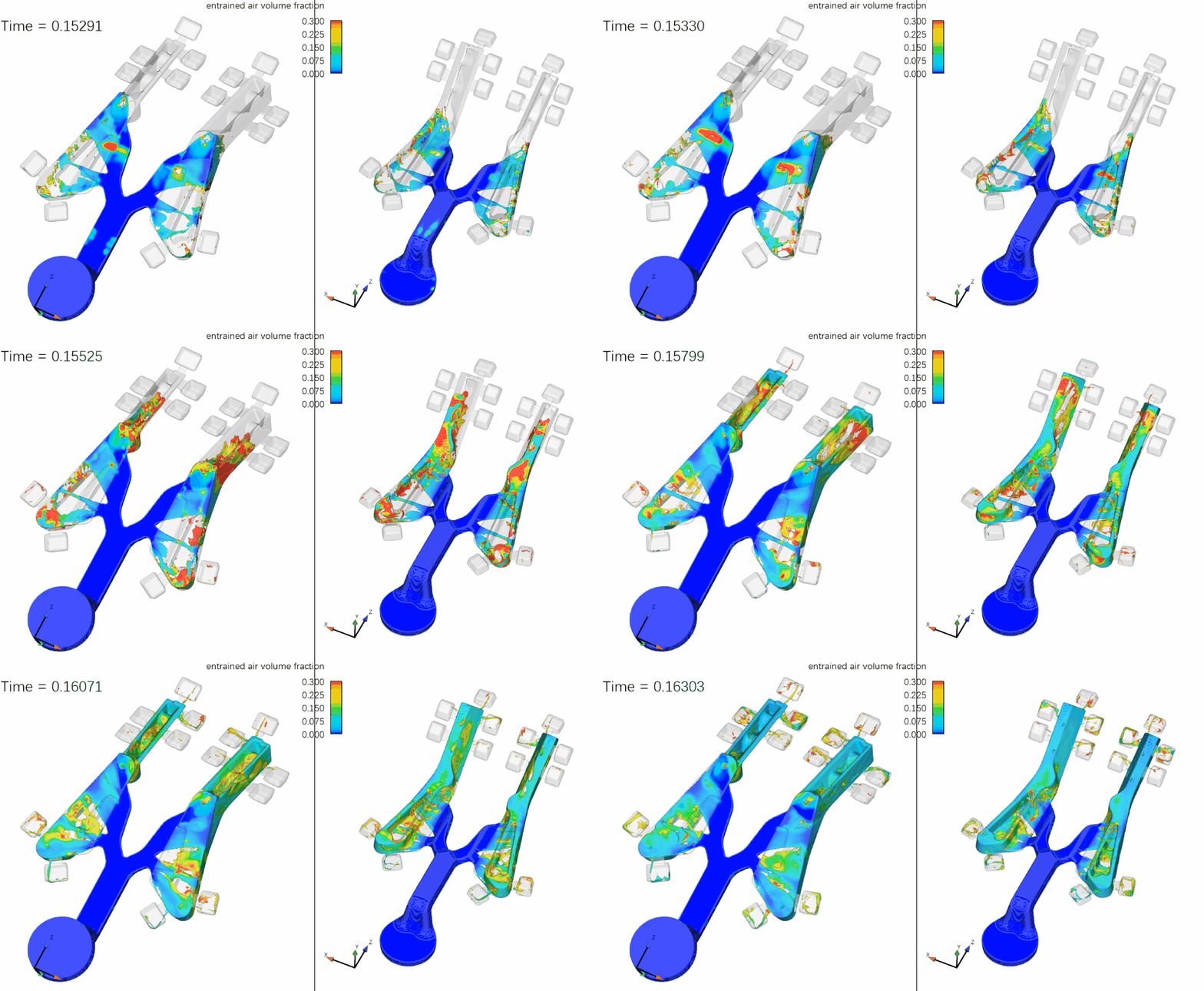
- Runner Structure Optimization: FLOW-3D software is deployed for comprehensive computational fluid dynamics (CFD) simulation. A tapered runner is designed to ensure that the aluminum melt fills the cavity in a stable laminating manner (laminar flow instead of violent turbulent flow), avoiding frontal air entrapment.
- Full-Scale Exhaust System: Large-area overflow grooves and high-efficiency vacuum exhaust valves are forcefully setup at the end of the cavity where the liquid metal converges last, ensuring that over 95% of the gas inside the cavity is forcefully extracted before the liquid metal arrives.
3. Die Casting Process Control: Microsecond-Level Closed-Loop Dynamic Injection and Precision Mold Temperature Linkage
① Slow Injection Phase (Low-Speed Air Venting)
- Control Key: The slow injection speed v1 is strictly calculated and controlled (typically between 0.15 to 0.3m/s).
- Technical Principle: In this phase, the injection piston advances forward, driving the aluminum melt in the shot sleeve to roll forward in a smooth, unbroken axial wave. Its physical core is to utilize the self-climbing level of the aluminum liquid to push the air inside the sleeve completely forward into the ventilation and overflow channels. Piston movement must not be too fast, which prevents the liquid metal from folding over and trapping air inside the sleeve.
② Fast Injection Phase (High-Speed Cavity Filling)Control Key:
- When the liquid metal reaches the critical junction between the runner and the inner gate (the critical switching point), the system switches instantly to the fast injection speed v2 (typically reaching 2.5 to 5.0m/s) within microseconds.
- Technical Principle: The aluminum liquid passes through the inner gate at an extremely high speed, completely filling the entire cavity within an ultra-short filling time (generally less than 100ms) to prevent the front edge of the liquid metal from premature solidifying. Simultaneously, it coordinates with the high-precision vacuum system to keep the cavity under ultra-low pressure, suppressing the entrapment probability to its absolute limit.
③ Intensification Phase (Instant Dynamic Squeezing)
- Control Key: At the instant the cavity is completely filled (a few milliseconds before the end of filling), the injection system transitions into the high-pressure intensification phase, with the intensification pressure P3 typically set between 70 to 100MPa.
- Technical Principle: Because aluminum alloy shrinks by about 3% to 6% during the liquid-to-solid transition, shrinkage holes easily occur in thick-walled sections (thermal nodes). At this moment, using the massive static pressure transmitted by the piston during the brief window before full solidification, the microscopic crystalline network is forcefully compressed mechanically. This creates an extremely dense grain arrangement and completely crushes the growth space of shrinkage holes and microscopic porosity.
④ Precision Mold Temperature Control (Achieving Thermal Balance and Directional Solidification)
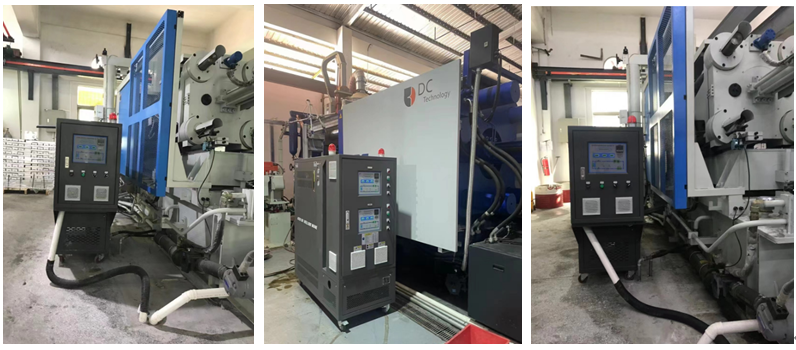
- Control Key: High-power precision mold temperature controllers (MTC) are utilized to maintain the mold surface temperature in a dynamic thermal balance state between 180°C to 280°C.
- Technical Principle: Working in tandem with multi-channel high-pressure spot-cooling water systems positioned close to the thermal nodes of the casting, the precision linkage of MTC temperature control and localized intense cooling creates a distinct "far-to-near" temperature gradient within the mold cavity. This forces the thin-walled parts furthest from the gate to solidify first, while the inner gate and main runner solidify last. Consequently, as the casting shrinks, an uninterrupted supply of high-pressure aluminum liquid from the runner achieves perfect directional feeding through the inner gate.
III. Final Verdict: Fully Digitalized Quality Traceability Closed Loop
To guarantee that every automotive part delivered to OEMs possesses flawless internal density, JIAZHAN Industrial has built a closed-loop non-destructive and microscopic inspection system:
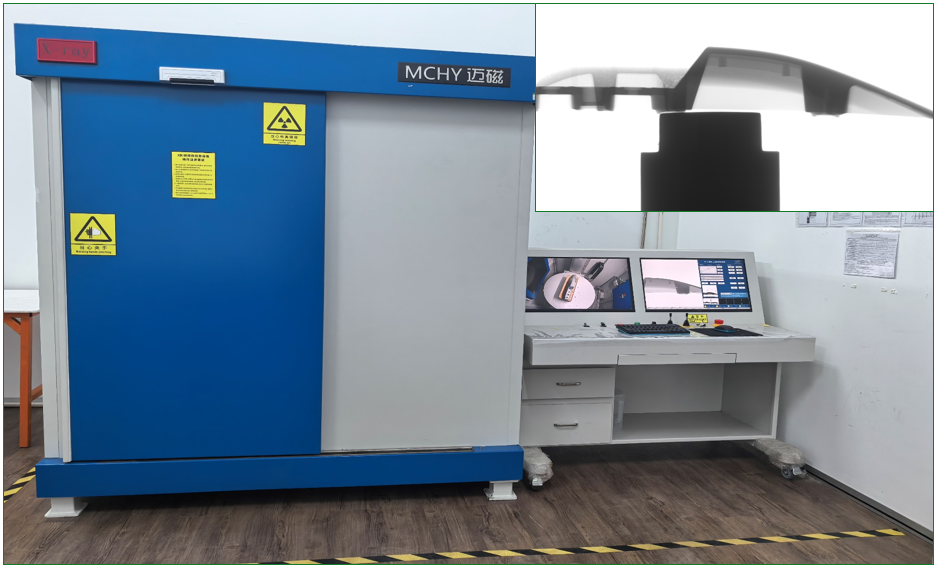
- Industrial X-RAY Non-Destructive Inspection: Utilizing a high-power (225kV), micro-focus (less than or equal to 10microns) X-ray inspection system, finished products undergo internal defect scanning. AI image algorithms automatically measure and calculate the diameter and volume percentage of defects, resolutely intercepting any component with out-of-spec porosity.
- High-Precision Coordinate Measuring Machine (CMM) While strictly checking geometric and dimensional tolerances, this ensures that the internal dense layer is not compromised after machining.
Technical Statement: JIAZHAN Industrial does not rely on luck to prevent blowholes. We rely on the digitalized closed-loop capabilities of material refining, CAE runner simulation, dynamic intensification, precision mold temperature control, and X-ray inspection to reduce the internal hole defect rate of aluminum die castings below the strictest thresholds of the automotive supply chain.
Related Solutions
No related solutions